
Newest FDA Approved Drugs for Lupus

posted in Drugs used in lupus on November 18, 2026 by
Updated October 15, 2026
The Newest FDA Approved Drugs for Lupus mentioned in Chapter 34 of The Lupus Encyclopedia are anifrolumab, belimumab, and voclosporin. On March 9, 2011, belimumab (Benlysta) became the first lupus drug the FDA had approved since hydroxychloroquine in 1955. For more than five decades before that, doctors borrowed new SLE drugs from other diseases. Our treatment of lupus guide shows where these three fit beside hydroxychloroquine.
NOTE: Johns Hopkins University Press, publisher of The Lupus Encyclopedia, is a nonprofit publisher. If you purchase JHUP books, like The Lupus Encyclopedia, you support projects like Project MUSE.
What This Chapter Includes
Three drugs built for lupus
This chapter takes on anifrolumab (Saphnelo), belimumab (Benlysta), and voclosporin (Lupkynis). The book calls them “the only drugs specifically developed for lupus.” Steroids and hydroxychloroquine already had their own chapters, so we leave them there. Kaleidoscope Fighting Lupus explains monoclonal antibodies, the group that includes Saphnelo and Benlysta.
Why high-dose aspirin dropped out
The sidebar ties aspirin to lupus pleurisy and lupus arthritis. Very high doses for those uses cause side effects in most patients. Therefore, we no longer use aspirin for those high-dose indications. We use low-dose aspirin, such as 81 mg daily, to help prevent heart attacks and antiphospholipid clots.
Anifrolumab Among the Newest FDA Approved Drugs for Lupus
Blocking type I interferon
“Around 70% of SLE patients have high type I interferon levels,” the book says. Anifrolumab “binds to the cell surface receptor” for that interferon and “keeps interferon from working.” Some patients “see improvements during the first month of treatment.” By the third month, most people who will respond already show those gains. It can also “reduce lupus inflammatory arthritis pain and swelling” and help patients need fewer steroids.
Skin results, and who the trials left out
In the trials, 49% with at least moderately severe skin lupus had a large drop in skin inflammation. They reached at least a 50% improvement by three months. Only 25% on usual lupus treatment hit that same mark. The trials left out severe lupus nephritis and severe neuropsychiatric lupus. Therefore, we cannot yet say how those two groups will do, though kidney studies are underway.
Shingles and a missed infusion
Patients taking anifrolumab were three times more likely to develop shingles than those on placebo. However, no severe shingles attacks occurred in those trials. Get at least one Shingrix shot two weeks or more before the first infusion. The monthly IV dose is 300 mg. If you miss one, get the infusion soon, and wait at least 14 days for the next.
Do not use anifrolumab while pregnant or breastfeeding. The book has not studied either situation. Because the drug is a large molecule, very little of it is likely to reach breast milk. Ask your doctor before you plan a pregnancy on Saphnelo.
Belimumab and the Newest FDA Approved Drugs for Lupus
B-cell fertilizer
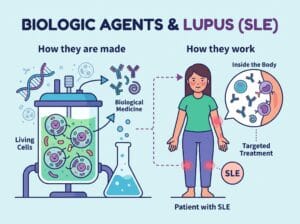
The FDA approved belimumab for SLE in 2011. In 2019 it became the first approved option for pediatric SLE as young as five. It then became the first drug approved for lupus nephritis in children and adults. The book says to “think of BLyS as B-cell fertilizer.” Belimumab “attaches to BLyS in the bloodstream and removes it,” so harmful B cells can die.
Who responds
It works especially well for skin lupus, arthritis, fatigue, and lupus nephritis. Patients with high anti-dsDNA or low complement have a better chance of responding. Twice as many belimumab patients reached low disease activity as those on placebo. A 2020 study found that seven years on belimumab cut the yearly chance of organ damage by 61%. The OBSErve and EMBRACE trials showed that Black patients responded well to belimumab.
Infusions, weekly shots, and breastfeeding
IV belimumab is 10 mg per kilogram of body weight. Three infusions come in the first month, then one infusion every four weeks. Adults can also inject 200 mg under the skin once a week. Lupus nephritis starts with 400 mg weekly for four weeks, then 200 mg weekly. The book says belimumab is safe during breastfeeding.
Take a home injection out of the fridge 30 minutes before you use it. If it stays out for more than 12 hours, discard it and contact the maker. More Than Lupus explains what starting Benlysta can look like, and it also covers newer lupus treatments.
Voclosporin for Lupus Nephritis
A faster drop in urine protein
The FDA approved voclosporin (Lupkynis) for lupus nephritis classes III, IV, and V on January 22, 2021. A decrease in urine protein can show up within two weeks. Almost twice as many patients go into remission as those on mycophenolate alone. Patients on voclosporin can also lower steroids more than patients who are not on it. The dose is three 7.9 mg capsules twice a day, on an empty stomach.
Grapefruit, blood pressure, and pregnancy
Do not drink grapefruit juice or eat grapefruit with voclosporin. Check blood pressure every two weeks during the first month. Skip the drug if a reading is higher than 165/105 mmHg, and call your doctor. One capsule contains 21 mg of alcohol, so avoid voclosporin in pregnancy and while breastfeeding.
If you are under four hours late, take the missed capsule. After four hours, skip it and wait for the next scheduled time. Also skip St. John’s wort, since it interferes with voclosporin levels.
Safety With the Newest FDA Approved Drugs for Lupus
Infections and mood
Do not start these drugs during an active infection. Therefore, call your primary care provider or go to urgent care if infection symptoms begin. On belimumab, tell your doctor right away about worse depression or any suicidal thoughts. Moreover, our lupus and infections page lists steps that lower that risk.
Vaccines
Do not get live vaccines on anifrolumab, belimumab, or voclosporin. You do not need to stop them for a flu shot, Shingrix, or a COVID-19 vaccine. For anifrolumab, try to get Shingrix before the first infusion. Our vaccine recommendations and COVID vaccine timing guide lay out the schedule.
We compare Saphnelo and Benlysta in our Saphnelo or Benlysta article. Our anifrolumab approval article covers how Saphnelo reached patients. Before surgery, ask whether to line up the operation with your usual dose. Ask your doctor which of these three drugs fits your organs.
For more in-depth information on Newest FDA Approved Drugs for Lupus:
Read chapter 34 of The Lupus Encyclopedia, edition 2
Look up your symptoms, conditions, and medications in the Index of The Lupus Encyclopedia
If you enjoy the information from The Lupus Encyclopedia, please click the “SUPPORT” button at the top of the page to learn how you can help.
What are your comments and opinions?
If you have lupus, what has your experience been? What do you recommend for other patients?
Do you have any questions to ask Dr. Thomas?
Please click on “Leave a Comment” above to comment.
Please support “The Lupus Encyclopedia” blog post page
Click on “SUPPORT” at the top of the page to learn how you can support “The Lupus Encyclopedia“
FAQs
What are the newest FDA-approved drugs for lupus?
Three drugs specifically developed for lupus are anifrolumab (Saphnelo), belimumab (Benlysta), and voclosporin (Lupkynis). Anifrolumab and belimumab target parts of the immune system involved in inflammation, while voclosporin helps treat lupus nephritis, a form of kidney inflammation caused by lupus. Doctors choose treatment based on a patient’s symptoms, affected organs, previous treatments, and individual health needs.
What is the difference between Benlysta, Saphnelo, and Lupkynis?
Benlysta (belimumab) blocks BLyS, a protein that helps B cells survive and can contribute to lupus activity. Saphnelo (anifrolumab) blocks the type I interferon receptor, reducing signals that drive inflammation. Lupkynis (voclosporin) helps control lupus nephritis and reduce protein in the urine. Although all three treat aspects of lupus, they work differently and are used for different treatment needs.
What precautions should patients take when using newer lupus medications?
These medicines can increase the risk of infections, so patients should tell their healthcare team about signs of infection before or during treatment. Live vaccines are generally avoided while taking these medications, although vaccines such as the flu shot, Shingrix, and COVID-19 vaccines may still be appropriate. Each drug also has specific precautions. For example, belimumab requires attention to changes in mood, anifrolumab increases the risk of shingles, and voclosporin requires blood pressure monitoring and avoidance of grapefruit. Discuss pregnancy, breastfeeding, other medicines, and vaccination timing with your specialist before starting treatment.
This article includes contributions from


No comment yet, add your voice below!
Leave a comment